Understanding Chromatography
Chromatography is among the most important separation techniques in modern science, underpinning pharmaceutical manufacturing, biopharmaceutical purification, food-safety testing, environmental analysis, and clinical diagnostics.
Chromatography first appears as an alphabet soup of acronyms — HPLC, UHPLC, FPLC, GC, SEC, IEX, TLC, HIC — and as a collection of seemingly unrelated methods, each with its own rules and equipment.
In reality, chromatography is a single, unifying concept: a mixture flows through a medium, its components move at different speeds, and they separate. The instrumentation, software, resin chemistries, and method names are all just ways of implementing that one principle.
This article is a practical primer on that principle: what chromatography is, how it works, its main types, and why it matters. It is the foundation for the rest of the series, which builds from here toward preparative purification and the techniques used to scale it.
1. Why Chromatography Matters: Real-World Impact
Chromatography is deeply embedded in modern life, helping ensure that medicines are safe, water is clean, foods are consistent, and research data are reliable.

- Pharmaceutical development and manufacturing Purifies small-molecule drugs, biologics (antibodies, proteins), vaccines, peptides, and oligonucleotides; quality-control labs use analytical HPLC and related techniques to assay active ingredients and monitor purity, impurities, and degradation products.
- Environmental analysis LC and GC detect pollutants — pesticides, industrial chemicals, and other contaminants — in air, water, and soil, often to parts-per-billion or parts-per-trillion.
- Food and beverage testing Ensures safety and quality by measuring vitamins, flavor compounds, additives, and residues of pesticides, mycotoxins, and veterinary drugs.
- Biotechnology and research Central to purifying and characterizing biomolecules in proteomics, metabolomics, and genomics workflows.
- Forensic and clinical applications GC–MS and LC–MS identify drugs of abuse, toxins, and unknown compounds in forensic labs; clinical labs measure analytes such as amino acids, vitamins, and therapeutic drug levels in patient samples.
2. What Is Chromatography? (Definition)
Chromatography separates the components of a mixture according to their differing interactions with a stationary phase and a mobile phase.
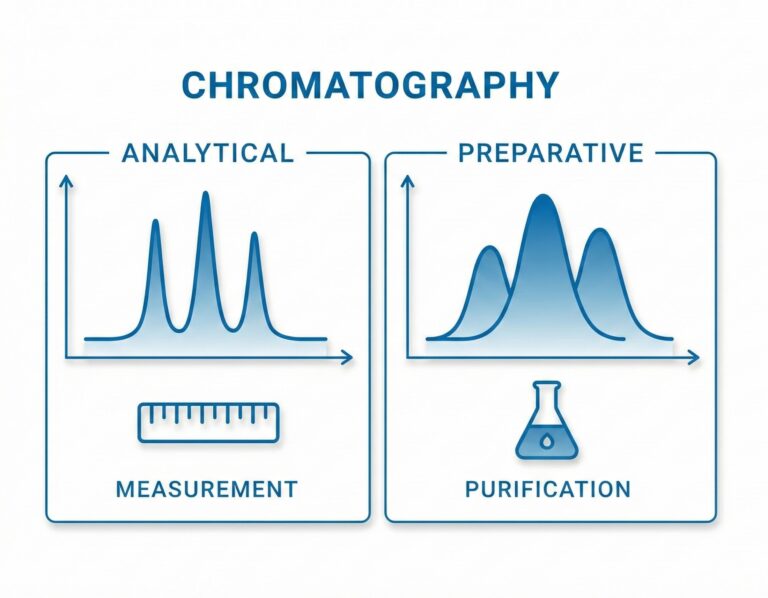
Chromatography is used to isolate, identify, and sometimes collect individual components of a complex mixture — both to gain information (analytical chromatography) and to obtain purified material (preparative chromatography).

The Two Phases: Stationary and Mobile
Every chromatographic method involves two distinct phases:
Stationary Phase
A material fixed in place that interacts with the sample components — porous beads packed into a column, a thin layer on a plate (TLC), or a membrane.
Mobile Phase
A fluid — liquid or gas — that flows through the stationary phase, carrying the sample with it.

How Chromatographic Separation Happens
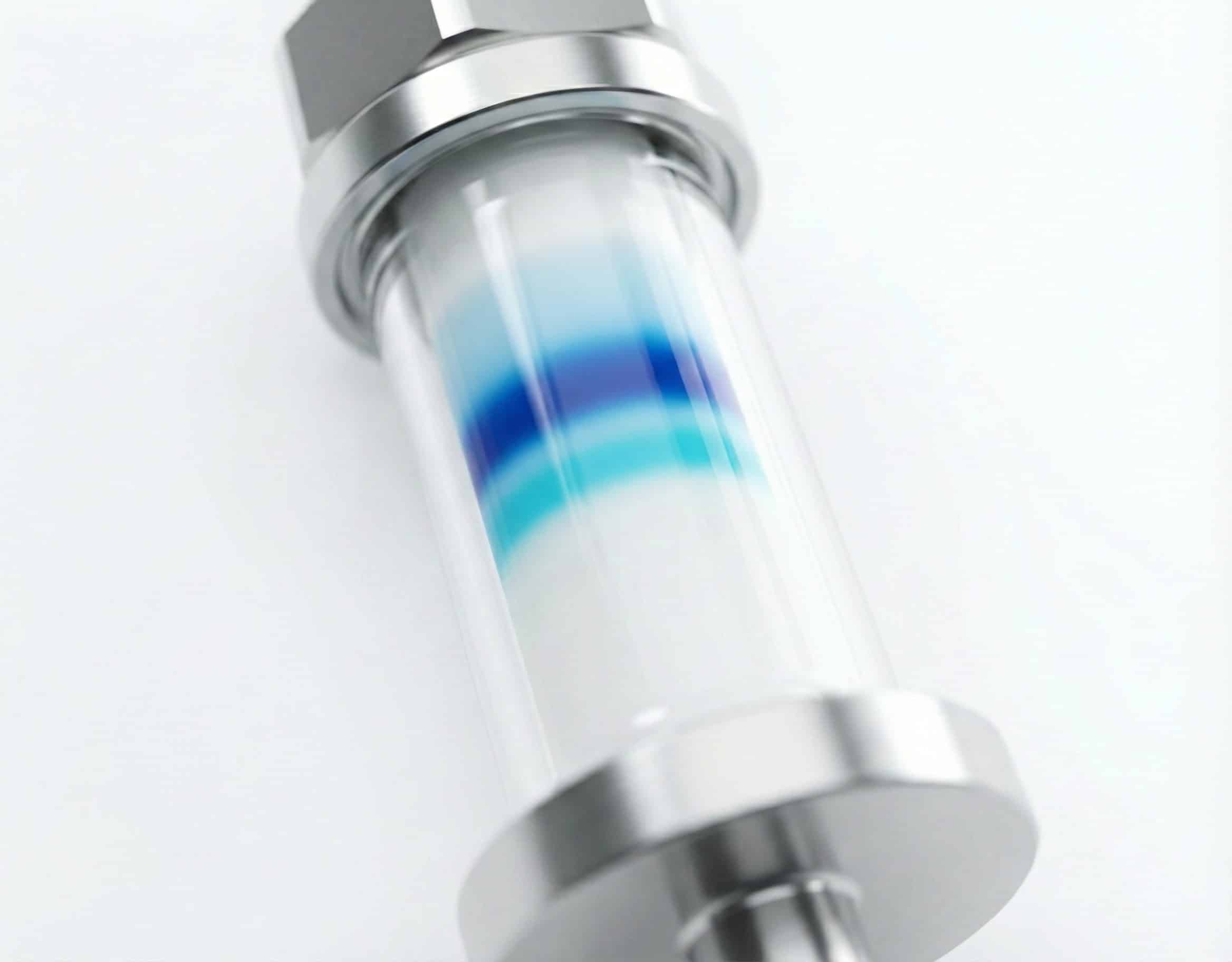
As the mobile phase moves through the stationary phase, each molecule spends a different proportion of its time in each phase:
- Molecules that interact strongly with the stationary phase move more slowly.
- Molecules that prefer to remain in the mobile phase move more quickly.
These differing migration speeds gradually separate the mixture: faster-moving species elute (exit the column) first, slower-moving ones later. The time a molecule takes to pass through is its retention time — and, as the next section shows, every mode of chromatography is simply a different way of making the target retain differently from everything around it.

A Simple Analogy
Imagine a running track with sticky patches:
- Each runner represents a different molecule.
- The track is the stationary phase.
- Air pushing the runners forward is the mobile phase.
Runners who get stuck more often (high affinity for the stationary phase) finish later; those who rarely stick finish earlier. By the finish line they are spread out — and in chromatography, that spread is the separation.
3. How Chromatography Works: Key Separation Mechanisms
If separation comes down to making molecules retain differently, the practical question is which property to exploit. Pick a property on which the target differs from its impurities, then use a stationary phase mechanism built to respond to it. The mechanisms below exploit the most useful molecular properties: polarity, charge, size, specific binding, and volatility.
Polarity: Adsorption and Partition Chromatography
Separation here is based on how polar or non-polar a molecule is, determining how it distributes between the two phases. This mechanism forms the backbone of several major LC modes:
Normal-Phase & HILIC
Uses a polar stationary phase (such as bare silica) and a non-polar mobile phase; polar compounds are retained longer and elute later. Hydrophilic Interaction Liquid Chromatography (HILIC) is a specialized variant used to separate highly polar compounds using aqueous-organic mobile phases.
Reversed-Phase (RPC) & HIC
The most common HPLC mode, RPC uses a non-polar stationary phase (hydrophobic) and a polar mobile phase; non-polar compounds elute later. Hydrophobic Interaction Chromatography (HIC) similarly exploits hydrophobicity, but uses high-salt aqueous buffers to gently separate fragile biomolecules like proteins.
Charge: Ion Exchange Chromatography (IEX)

When the property is charge rather than polarity, the mode is ion exchange. It separates molecules by electrical charge, using a resin functionalized with charged groups:
- Anion exchangers carry positive charges and bind negatively charged molecules.
- Cation exchangers carry negative charges and bind positively charged molecules.
Bound molecules are later eluted by changing pH or salt concentration. Ion exchange is widely used to purify proteins, peptides, and amino acids.
Size: Size Exclusion Chromatography (SEC)
Some separations exploit no chemical interaction at all, only size. Size exclusion chromatography, also called gel filtration, uses a porous stationary phase as a molecular sieve:

- Small molecules can enter the pores, taking a longer, more tortuous path.
- Large molecules cannot enter the pores and move around them, taking a shorter path.
Large molecules therefore elute first, smaller molecules later. SEC is widely used to characterize polymers, desalt samples, and separate target proteins from unwanted high-molecular-weight aggregates.

Specific Binding: Affinity Chromatography (AC)
The most selective property of all is a molecule’s specific shape or binding site. Affinity chromatography exploits it through a lock-and-key interaction between a ligand immobilized on the stationary phase and a specific target molecule in the sample.

- The target molecule binds strongly and is retained.
- Non-binding components wash through and are removed.
- The target is then eluted by shifting conditions (such as altering pH, increasing salinity, or introducing a competitive ligand) to safely disrupt the lock-and-key interaction.
Because the interaction is so specific, affinity chromatography can deliver very high purity in a single step. It is a cornerstone of antibody and protein purification in biopharmaceutical manufacturing.
Volatility: Gas Chromatography (GC)
The properties above all operate in a liquid mobile phase, but separation can also be driven by volatility. Gas chromatography separates compounds by how readily they vaporize and how they interact with a coated stationary phase inside a narrow capillary column; the mobile phase is an inert gas such as helium or nitrogen. GC suits small, volatile organic compounds — solvents, fragrances, and environmental pollutants.
4. Core Components of a Chromatography System
Although chromatographic systems vary widely in complexity and scale, they share a common architecture. These building blocks are the basic vocabulary of chromatography.
The material to be separated — a blood sample, fermentation broth, plant extract, or reaction mixture.
The moving liquid or gas that carries the sample through the system — a solvent or solvent mixture in LC, an inert gas in GC.
Drives the mobile phase through the system at a defined flow rate and pressure; HPLC uses high-pressure pumps to push solvent through tightly packed columns.
Where the separation occurs. The stationary phase (often called resin in LC) is packed into the column; its chemistry and physical properties determine how components separate.
A device at the column outlet that senses compounds as they elute. Common types include UV–Vis absorbance (LC), flame-ionization detectors (GC), and mass spectrometers (LC–MS, GC–MS).
The detector’s output, showing how the signal changes over the course of a run.
After detection, separated components either go to waste or are collected in separate containers for further use or analysis.

5. How to Read a Chromatogram
A chromatogram is the visual output of a chromatographic run — typically a plot of detector signal (Y-axis) against time (X-axis).
Key Features of a Chromatogram
- Baseline The flat signal when only mobile phase passes through the detector and no analytes are eluting.
- Peaks As a separated compound elutes, the signal rises and falls, forming a peak; ideally each peak corresponds to a single component (analyte).
- Retention time (RT) The time from injection to a peak’s maximum. Under fixed conditions, each compound has a characteristic retention time, usable for identification.
- Peak height & area Peak size correlates with the amount of analyte. Because peaks naturally broaden the longer they remain in the column, quantitation relies on peak area, which provides a much more robust and accurate measure of total mass than peak height.

Assessing Separation Quality
Two important indicators of separation quality are resolution and peak shape.
- Resolution How well two peaks are separated. Good resolution shows distinct, baseline-separated peaks; poor resolution appears as overlapping or merged peaks (co-elution).
-
Peak shape
- Symmetrical, narrow peaks indicate an efficient, ideal separation where the sample concentration is low enough to match a linear adsorption isotherm.
- Tailing features a steep, sharply rising leading edge followed by a long, drawn-out trailing edge. In analytical runs, this usually points to secondary chemical interactions (such as basic analytes sticking to residual acidic silanols). However, in preparative chromatography, it is the classic signature of mass overloading under a Langmuir isotherm. As high sample concentrations saturate the stationary phase, excess target molecules travel faster and pile up at the front of the band, creating a distinct “shark-fin” or “sailboat” profile.
- Fronting is the mirror image of tailing, displaying a gradual leading edge that ends in a sharp drop-off (an anti-Langmuir profile). It is far less common in standard liquid chromatography, typically arising from unusual adsorption chemistry or from dissolving the sample in a solvent significantly stronger than the mobile phase.
- Broad peaks indicate slow elution or excessive column dispersion, which drastically reduces resolution.

6. Types of Chromatography: The Practical Toolbox
While Section 3 categorized chromatography by the molecular property it exploits, practitioners also group these techniques by their physical phase and equipment. Understanding both classifications allows you to mix and match concepts — such as pairing a liquid mobile phase (LC) with a charge-based mechanism (IEX) — to map out a complete purification strategy.
By Physical Phase
- Liquid chromatography (LC) The mobile phase is a liquid. Highly versatile, handling small molecules, peptides, proteins, and oligonucleotides.
- High-performance liquid chromatography (HPLC) A high-resolution, high-pressure form of LC that uses tightly packed columns and small particles for fast, efficient separations.
- Gas chromatography (GC) The mobile phase is a gas; analytes must be volatile and thermally stable. GC excels at volatile organic compounds — solvents, flavors, and pollutants.
- Planar chromatography (e.g., TLC) The stationary phase is coated on a flat plate, and the mobile phase rises by capillary action. TLC is simple, low-cost, and ideal for quick qualitative checks.
By Separation Mechanism
Grouped by the dominant interaction — the properties from Section 3 — the common modes are:
- Polarity-based Normal-phase, reversed-phase, and hydrophilic interaction chromatography (HILIC).
- Ion exchange (IEX) Separates charged analytes by electrostatic interactions.
- Size exclusion (SEC) Separates molecules by size using porous beads.
- Affinity chromatography (AC) Uses specific biological or chemical binding to capture the target.
- Hydrophobic interaction chromatography (HIC) Separates biomolecules by hydrophobicity under high-salt conditions.
7. Analytical vs. Preparative Chromatography
Chromatography can also be categorized by its primary goal — information versus purification.

- Goal Identify what is in a sample and how much (qualitative and quantitative analysis)
- Scale Very small samples (microliters, micrograms)
- Focus High resolution, sensitivity, and reproducibility; ideally every component is baseline-separated for accurate quantitation
- Equipment Small-bore columns packed with fine particles, and highly sensitive detectors (HPLC, UHPLC, LC–MS, GC–MS)
- Outcome A chromatogram and numerical data; separated components are usually discarded after detection

- Goal Purify and collect material — a drug substance, intermediate, or target protein
- Scale Larger sample amounts (milligrams in research, grams to kilograms in manufacturing)
- Focus Purity, yield (recovery), and throughput; complete resolution is desirable but may be traded against speed and capacity
- Equipment Larger columns and higher flow rates, often with automated fraction collection
- Outcome Isolated fractions containing the target component for downstream use
A typical workflow runs an analytical HPLC method first to understand the mixture, then scales the optimized method to a preparative setup to collect grams or kilograms of a specific component.
That distinction — information versus material — is where the series goes next. Part II, What Is Preparative Chromatography? takes the preparative side and shows how the single goal of collecting material reshapes the whole system, from column size to detector design.
8. Key Chromatography Terms (Glossary)
| Term | Definition |
|---|---|
| Affinity chromatography (AC) | A chromatography mode where the stationary phase contains ligands that selectively bind a specific target molecule. |
| Analyte | The substance or molecule being detected, measured, or purified in a chromatography run. |
| Analytical chromatography | Chromatography performed to identify and quantify components in a sample, typically at small scale. |
| Chromatogram | A plot of detector signal versus time that visualizes analyte separation during a run. |
| Column | A tube packed with stationary phase where the separation process occurs. |
| Detector | An instrument that measures compounds as they elute from the column and converts the signal into data. |
| Elution | The process of washing analytes from a chromatography column using the mobile phase. |
| FPLC (Fast Protein Liquid Chromatography) | Low-pressure liquid chromatography using biocompatible materials, designed for gentle purification of large biomolecules. |
| Gas chromatography (GC) | A chromatography technique using a gas as the mobile phase, ideal for volatile compounds. |
| HIC (Hydrophobic Interaction Chromatography) | A separation mode optimized for fragile biomolecules that exploits surface hydrophobicity using high-salt buffers. |
| High-performance liquid chromatography (HPLC) | An advanced form of LC that uses high pressure and fine particles for improved resolution and speed. |
| HILIC (Hydrophilic Interaction Liquid Chromatography) | A variant of normal-phase chromatography used to separate highly polar compounds using aqueous-organic mobile phases. |
| Ion exchange chromatography (IEX) | A separation mode that uses charged stationary phases to separate analytes by charge. |
| Liquid chromatography (LC) | Chromatography using a liquid mobile phase; widely used for small and large molecules. |
| Mobile phase | The liquid or gas that flows through the chromatographic system and carries the sample. |
| Preparative chromatography | Chromatography designed to purify and collect larger quantities of material, focusing on purity and yield. |
| Resin | The stationary phase material (often porous beads) used inside liquid chromatography columns. |
| Resolution | A measure of how well two analyte peaks are separated from each other. |
| Retention time (RT) | The time between sample injection and the apex of a chromatographic peak. |
| Size exclusion chromatography (SEC) | A chromatography mode that separates molecules by size using porous media. |
| Stationary phase | The fixed phase that interacts with analytes and slows their movement, enabling separation. |
| Thin-layer chromatography (TLC) | A planar chromatography method where the stationary phase is coated on a flat plate and separation occurs by capillary action. |
| UHPLC (Ultra-High-Performance LC) | An evolution of HPLC utilizing extremely small particles (sub-2 µm) and very high pressures (up to 1000+ bar) for maximum analytical resolution. |
9. Frequently Asked Questions About Chromatography
The name comes from Greek roots meaning “color writing”: early chromatography separated plant pigments into colored bands on a column. Today it applies to many substances invisible to the eye, with modern detectors (UV or mass spectrometers) revealing colorless compounds during separation.
These three terms are often used loosely, a common source of confusion. They describe nested things:
- The stationary phase is the material that interacts with the sample and does the separating.
- In liquid chromatography, that material is usually a resin — porous beads carrying the active chemistry.
- The column is the tube that holds the packed resin in place.
So the column contains the resin, and the resin is the stationary phase. (In GC or TLC the stationary phase takes a different form — a coating on a capillary wall or a flat plate — but its role is the same.)
The primary difference is the mobile phase:
- GC uses a gas as the mobile phase and requires analytes that can be vaporized without decomposing. It is ideal for small, volatile compounds.
- LC uses a liquid mobile phase and handles a far wider range of analytes, including large and thermally sensitive molecules such as proteins, peptides, and polymers.
High-performance liquid chromatography (HPLC) is an advanced form of liquid chromatography that uses:
- High-pressure pumps to drive solvent through the system.
- Columns packed with very small particles to increase surface area and resolution.
- Highly sensitive detectors and automated data analysis.
Compared with older gravity-driven methods, HPLC delivers faster, more efficient, more reproducible separations, and is the standard for modern analytical chromatography.
Yes. Chromatography is a core technology in protein and nucleic acid purification. Common strategies include:
- Affinity chromatography to selectively capture specific proteins (for example, antibodies binding to Protein A ligands).
- Ion exchange chromatography to separate proteins by charge.
- Size exclusion chromatography to separate by size and remove aggregates.
For DNA, RNA, and oligonucleotides, specialized ion exchange and reversed-phase methods are often used at both analytical and preparative scales.
Often yes, though it may require method optimization or specialized columns. Compounds with very similar properties may initially co-elute; to improve resolution:
- Adjust the mobile phase composition, gradient, pH, or temperature.
- Select a different stationary phase chemistry.
- Use a more selective mode (for example, chiral chromatography for enantiomers).
- Combine techniques in two-dimensional chromatography, using two different columns in sequence.
Sensitivity depends on the detector. Coupled with mass spectrometry (LC–MS or GC–MS), chromatography can detect analytes down to the picogram or femtogram range, suitable for trace impurities in pharmaceuticals or pollutants at very low concentrations in environmental samples.
It depends on what you need when the run is over. For information — what is in a sample and how much — use analytical chromatography; the sample is consumed in the measurement. For material — a purified component collected in usable quantity — use preparative chromatography. Many projects use both: an analytical method first to understand the mixture, then a preparative method to collect the target. Part II, What Is Preparative Chromatography?, covers the preparative side in detail.